Those who wish to do work with stereoscopic graphics or video have hadto spend many thousands of dollars for cards, multisync monitors and LCDglasses and have had to make their own software. Gloves and other deviceshave cost thousands more. 3-D TV Corporation has created low cost universalinterfaces that can drive LCD stereo glasses and several models of lowcost StereoVisors (LCD viewing glasses). Several of these interfaces haveports for gloves and related devices. Software drivers for the glassesand other devices are available. Complete systems for interactive stereoimaging or viewing are now available for nearly any computer or video systemfor any size screen or audience for less than a tenth the previous costs.
MODEL SS4 will permit NTSC composite, YC, RGB or VGA(with a VGA to NTSC,YC or 60Hz analog RGB converter) input and output and will also do sideby side compression and/or decompression of stereo pairs in real time froma pair of video cameras to tape or from tape to HMD's or dual projectors.It also will shift either field horizontally or vertically to correct parallaxerrors or create real time stereo image manipulations. Any HMD, projector,video recorder or pair of genlocked cameras will interface with the SpaceStation to give a full 60Hz per eye. Resolution is 756x243 per eye(756x486when viewed in stereo) with 32000 colors. This is the maximum and actualapparent resolution and color quality will depend on the quality of sourceand displays. A smart line doubler can be added on the display end in anyof these cases, which will double the apparent vertical resolution whenhigh resolution projectors or HMD's are used. Thus an apparent verticalresolution approaching 1000 lines would be obtained. The use of smart linedoublers may eliminate any advantage of dual recording(two VTRs) in mostcircumstances.
MODEL SS3 is identical to the above except that input and output videois in PAL and 50Hz per channel is output. Resolution is 768x576 with 32,000colors.
Most, if not all, LCD projectors require the use of polarizers in anonstandard vertical and horizontal orientation to avoid odd color artifacts(45degrees to right and left is standard for polarized glasses). One can usea piece of 1/2 wave plate in front of each polarizer to rotate the angleback to the standard. If tearing or jumping of the image is seen, thisis probably due to poor signal quality. This is especially likely if thesource is VHS tape being played on a consumer VCR. In such cases it isnecessary to run the signal from the tape player through a time base corrector(TBC)or to use professional VCR's and tape formats.
Several models of dual LCD head mounted displays are available from3DTV Corp. They can be used with various models of the StereoDemultiplexeror Space Station for input from field sequential stereoscopic video and/orcomputer sources.
Many low cost programs are becoming available for creating stereo graphicson ordinary PC's. StereoPro IMAGINE for PC, Lepton VR Toolkit, REND386& it's successor VR386, VistaPro, 3DFLI, 3DFLC, 3D MAGIC, 3D G0, OX,& VR Slingshot are some games & graphics tools supporting the framesequential format with LCD glasses drivers for serial & parallel ports.REND 386 is an assembly language renderer that will run on any 386 or 486and also has software to control the POWER GLOVE and slots for 3D mice,headtrackers, etc. 3DFLI & 3DFLC are new programs from 3DTV Corp. whichmerges a right and left stereo animation in FLI format and drive the glassesfor stereo viewing. 3DTGA merges separate right & left Targa filesto produce interlaced recordable 3D video .VistaPro is a program with stereocapability for viewing digital elevation maps on the Amiga and PC. It'slovely images can be viewed in stereo on the Amiga with the PC3D, PCVR, Model 75(joystick port), Model 2001 or Model 3000 StereoDriver interfaces.Because frame sequential stereo graphics requires page flipping which notall cards support in HiRes modes & necessitates 4 pages for animation(2for the displayed pair & 2 for the rendering pair) it imposes somesignificant limitations on programming. The much simpler above/below methodhas been adopted by programs like VREAM, VR Creator, Lepton VR Toolkit,World Toolkit, Division, SuperScape, Navigator etc. It splits the screenhorizontally putting the stereo pair above & below with a black barin-between. 3DTV's StereoSpace interface is than put in line between theVGA card & the monitor. StereoSpace inserts an extra sync pulse inthe black band, the monitor displays twice as many fields at 1/2 the verticalresolution & drives the LCD glasses in sync. A multisync monitor willscan at double speed automatically. If you have an ordinary monitor, somereadjusting of the frequency of the VGA card will be necessary to finda frequency that the monitor is happy with. Repositioning the image, changingresolution etc. will also change frequency. Some cards & monitors willbe difficult to match unless you are very familiar with programming theVGA chip. However, many have been surprised to find their old VGA monitorswith maximum listed specs of 90Hz, running as high as 140Hz. Robert Akkaof Chasm Graphics has recently released a lovely stereo graphic packagecalled Sudden Depth which automatically produces correctly formatted stereopairs from several file formats including 3D Studio & AutoCAD. Thisdoes not however let you produce stereo step by step within the program.For this, you must use another CAD package like PointLine or the SpaceBlaster with an AutoCAD plug in from 3DTV(avail. 1995). For display of still(non-animated)stereo pairs on the PC, the StereoPro software merges the images in PCXor GIF format and drives the LCD shuttering glasses through the PCS serialor PCP parallel interfaces. The shareware program Paint Shop Pro includedon the disc will convert other files to PCX or GIF. The images are stillstereo pairs, but with MakePath™, and lots of disk space, one can makestereoscopic animations by making separate left and right PCX files. Onecan then use DTA20 or Animator Pro 1.3, to convert these to FLIC filesand 3DFLIC™ to view the animations in stereo. The CD-ROM version of VistaProincludes a stereoscopic virtual bungee jump into the Grand Canyon usingthis route, but the stereo is not well done. The StereoMac kit availablefrom 3DTV Corp. (Fig. 7)has a real time black and white line drawing stereoprogram with source code in Think C and supports color images at reasonablefrom rate on the more powerful machines. A full screen stereo display driverfor the Mac is supposed to appear in 1995. A neat trick that can be exploitedto do 3D on Macs appears in the 2D freeware game ARASHI. The color paletteis divided into two 8 bit color images which can be used as a stereo pair.Several versions of the game & its source code are available on theMac Dev forum of CompuServe, Stanford.edu & other places on the net.The AMI VR™ and Amiga version of the StereoPro™ kits from 3DTV Corp. havestereoscopic games and a program for toggling the LCD glasses when theModel 75 StereoDriver is plugged into the Amiga joystick port. An Amigastereoscopic software development systems are also available.
Flicker with standard low cost computer systems can be small or evenimperceptible if the problem is understood and all parameters are controlled.Ambient light from windows and overhead lights should be reduced. Avoidanceof high luminosity areas in the image(especially large white patches) isnecessary. Most of the LCD glasses that have been marketed have incorporateda layer of black plastic in front of the LCD to reduce room brightness.Even field sequential video displayed in the European 50Hz PAL system canbe quite acceptable if these precautions are taken. Most PC VGA cards runat 72Hz which much reduces flicker even in bright environments. Recently,we have begun to incorporate a flicker fixer in our stereo programs. Thistakes advantage of the fact that most cards can be set at 3 different frequencies.With my ATI Ultra Pro card & the flicker fixer in our 3D GO game, defaultran at 72Hz, choice 2 ran at 84Hz & choice 3 at 94Hz. Of course yourmonitor must be capable of this also. It is not difficult to increase thefrequency by using your card menu.
Stereoscopic video is most conveniently and inexpensively created witha pair of genlocked cameras and the Model 100(composite) or Model 200(component)StereoMultiplexer available from 3DTV Corp. These units are battery poweredand about the size of VHS. They produce a 60Hz (or 50Hz for PAL) fieldsequential output. The Model 200 also has horizontal & vertical splitfield display which is of great help in matching the images of the twocameras. Used in conjunction with the SpaceStation, this permits recording60 fields per second from each of the cameras on a single tape in the compressedside by side or over/under formats with playback of all fields. The Model300 permits use of non-genlocked cameras and also reduce the interval betweenright and left fields to an average of 1/90th second compared to 1/60thwith the use of genlocked cameras. If the SpaceStation is used in conjunctionwith the Model 200 StereoMultiplexer to record all fields of two genlockedcameras, there is no delay between right & left eye recording &if this tape is played back with an HMD or twin projector display, thereis no delay in display of the right & left fields. Stereo video canbe genlocked to stereo graphics easily, but one has to be alert to matchup the right eye pairs. This subject has been explored extensively by Milgram,Dracsic and their colleagues in Canada. See their paper and the 3D ROM(http://vered.rose.utoronto.ca). The same comments on flicker apply asfor graphics .A white level reducer should help to reduce screen flickerbut of course flicker due to ambient light would be the same. A more sensibleapproach would be to process the master tapes to reduce the white level.This is done by adjusting the knee of the video sensitivity which can bedone on many cameras or on units such as the DaVinci DVE. My tests showedthat reducing the whites by 10 IRE units while raising the blacks &grays to compensate produced a satisfactory image with significantly reducedflicker. Diner has shown that matching the brightness of the two camerasvery closely significantly reduces flicker. Special adjustments are necessarysince most camera brightness controls are too imprecise. The multiplexersgive field sequential stereo for recording and for aligning cameras andviewing stereo with any CRT. The SpaceCard or SpaceStation converting 50or 60 Hz stereo to any desired frequency in NTSC, PAC or VGA is availablefrom 3DTV Corp. A relatively inexpensive FlickerFixer™ Box for increasingfrequency by NTSC and PAL TV's will be introduce by 3DTV Corp.
A single 3 tube CRT projector with the 3DTV Corp. StereoPlate in frontof the lenses and a polarization preserving screen allows viewing by manypeople with cheap circularity polarized paper or plastic glasses. It hasthe more crosstalk & less brightness than two projectors but is cheaper& occupies less space.
The use of two video projectors with crossed polarizes and a front orrear projection polarization preserving screen gives a large screen andallows the use of cheap, standard polarized glasses. In general, it willalso give less ghosting than with a single field sequential display whetherprojected or direct view with active glasses (or with passive glasses andthe StereoPlate). This is due to phosphor persistence in the active glassescase and phosphor persistence combined with scattering by LCD modulatorin the passive glasses case, since these problems are absent with the crosspolarized dual projector system. Also, 100 or 120 Hz monitors and projectorsare costly. Two genlocked computers can generate the images or two videoplayers can be run in sync with right eye and left eye time coded tapesand a suitable edit controller. Most frame accurate systems are quite expensive.A single field sequential source input to the StereoDemultiplexers from3DTV Corp. will output two separate signals of about 30Hz(depending oninput frequency) alternating with video black. This will flicker most with50Hz PAL input and CRT projectors and least with 72Hz VGA input and LCDprojectors. The LCD projectors are slower and flicker may be undetectableeven when each projector is input with 30Hz NTSC fields alternating withblack. However, use of the SpaceStations approximately doubles the brightness,an effect more noticeable with LCD than with CRT projectors. Most, if notall, LCD projectors require the use of polarizers in a nonstandard verticaland horizontal orientation to avoid odd color artifacts(45 degrees to rightand left of vertical is standard for polarized glasses). Using a pieceof 1/2 wave plate on each projector will restore the standard angle. Projectorsbeing planned with a single LCD may not have this problem.
I recently compared two 3 tube Sony projectors with field sequential3D input from NTSC SVHS tape output from the Model A StereoDemultiplexer(30Hzvideo alternating with 30Hz black for both the left and right eye projectors)(Fig.9) versus 60Hz per projector from the Model 4 SpaceStation. images werecross polarized and front projected on a silver screen viewed from within3 meters of the screen, the Model 4 gave a superior image primarily dueto the absence of observable line structure, but also due to the completeabsence of flicker and greater brightness. The flicker with the 30 Hz pereye system was mild, particularly if the image brightness was decreasedand carefully matched for the two projectors. The conclusion is the sameas that from my work with 60Hz(30Hz per eye) monitors: one can obtain agood quality stereo image suitable for prolonged viewing and professionaluse with 30Hz per eye provided ambient illumination can be reduced andcareful attention is given to the creation and display of the images. Ialso compared circular versus linear polarizers with this system and foundthat when the head is tipped less than about 10 degrees to either side,the linear system gives less ghosting, but at greater angles, circularpolarizers are best. In view of the greater cost, lesser availability andincompatibility with linear systems, it seems unnecessary to use the circularsystem. I have reached the same conclusion with 3D film and slide systemstwice before.
Simultaneous recording of the left and right images is easy for thosewho want the option of comparing dual VTR and single VTR techniques. Itis also useful to have separate R and L tapes when doing standards conversionsince standards converters (except the 3DTV Corp. Model) will destroy fieldsequential stereo. The R and L tapes can be separately converted and thenmixed into stereo in the new standard with the StereoMultiplexers. However,artifacts may be introduced and now that 3DTV Corp. has introduced theSpaceStations, dual recording probably has no advantage in most cases.
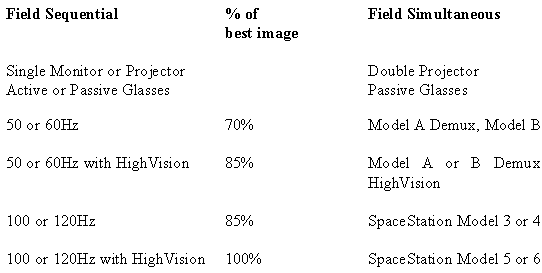
The following table may be useful to those trying to decide which displayoption will best suit their needs. It is highly subjective, being basedon my own judgment, and image quality will also vary with subject matter,quality of stereo, monitor or projector model, ambient illumination andother factors. Active glasses are LCD shuttering glasses. Passive glassesare circular or linear polarized glasses with polarized images createdwith an active LCD plate(StereoPlate) on the single monitor or projectoror with polarized sheets placed over the lenses of the double projectors.The Model A Demux sold by 3D TV Corp. separates field sequential compositevideo into separate right and left channels with 30Hz images alternatingwith 30Hz black fields. The Model B Demux does the same with compositeor component input. HighVision™ is the smart line doubler marketed by 3DTVCorp.